Module 306 - Carry out small it projects
Those are my course notes for the module 306 in the modulbaukasten.
tests
| description | weighting |
|---|---|
| projectdocumentation phase analysis | 30% |
| projectdocumentation phase concept | 20% |
| projectdocumentation phase implementation planning | 30% |
| project presentation | 20% |
Definitions
Competence
Competence = Knowledge*Capability*Wanting. If a person doesn't want to do
something, it doesn't matter if it can do something or knows how to do it.
Kleinprojekt (small project)
A project is something that is not daily business. It is a special task, however not all special tasks are projects. A project has to meet certain criteria, which defined differently from company to company. For one company, an employee dinner could be considered as a project, for others not.
The definition for a small project is also variable from company to company. Usually a small project is defined as a project, where no more than 150 person days are spent and no more than 50'000.-.
Please note the general criteria for projects. A project has:
- a defined end date
- not been done already
- brings some risk
- returns measurable results
The magical triangle
This triangle describes the following triangle; each edge has a definition:
enddate, project cost and quality. If something is "pulled" then the
other ones will get pulled too:
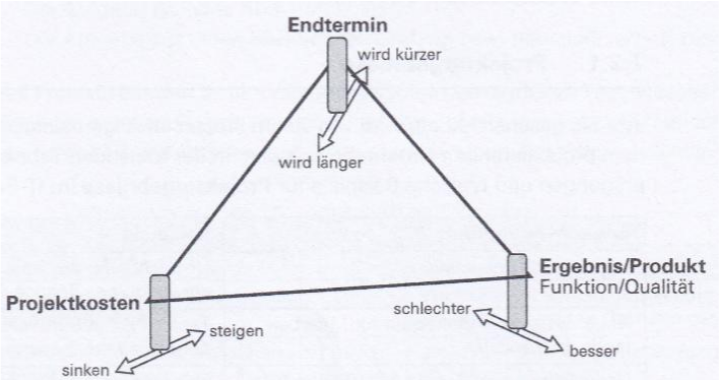
If the enddate is pushed forward to a later date, the project cost increase.
If the project cost sink, the enddate is pushed backwards as well as
the quality.
If the quality increases, the project cost increases aswell as the
enddate.
AKURE
Akure is a method to project similar to the IPERKA method. The letters mean:
- A: Pre-Analysis
- K: Konzept (concept)
- U: Umsetzungsplanung (implementation planning)
- R: Realisierung (implemention)
- E: Einführung (introduction)
Agile
Agile defines somethign that can adapt quickly to changes and is pretty easy while doing so. This does not only include project management methods but almost everything.
Framework Conditions
There are six major framework conditions (Rahmenbedinungen), which can be seperated into tow different categories; The environmental conditions and the conditions from the client:
Environmental conditions:
- Legal norms: A worker is not allowed to work more than legally allowed.
- Technical conditions: Slow computers cannot run high quality AI models.
- Ressources: There may be not enough humans to work on a given project.
Client conditions:
- Money: A given amout of money can be spent for this project.
- Contents: Devices should be bought and not rented.
- Time: A deadline is set for every project.
Business Case
The business case reasons a project. It tells the reader how this project is valuable for the company. In a business case there are usually 7 topics, which need to be addressed:
- Goals: What are the project's goals? What should it improve?
- Feasability: Can the project actually be done?
- Stakeholder: Who are the stakeholder's?
- Cost: How mucuh does the project cost? In numbers.
- Benefits: Why should this project get approved? Does it save some money/time? In numbers.
- Time: When is the project start/end? How many person days?
- Risks: What could go wrong? What happens if the project will not get used in the end?
A business case is somewhat similar with a project proposal.